




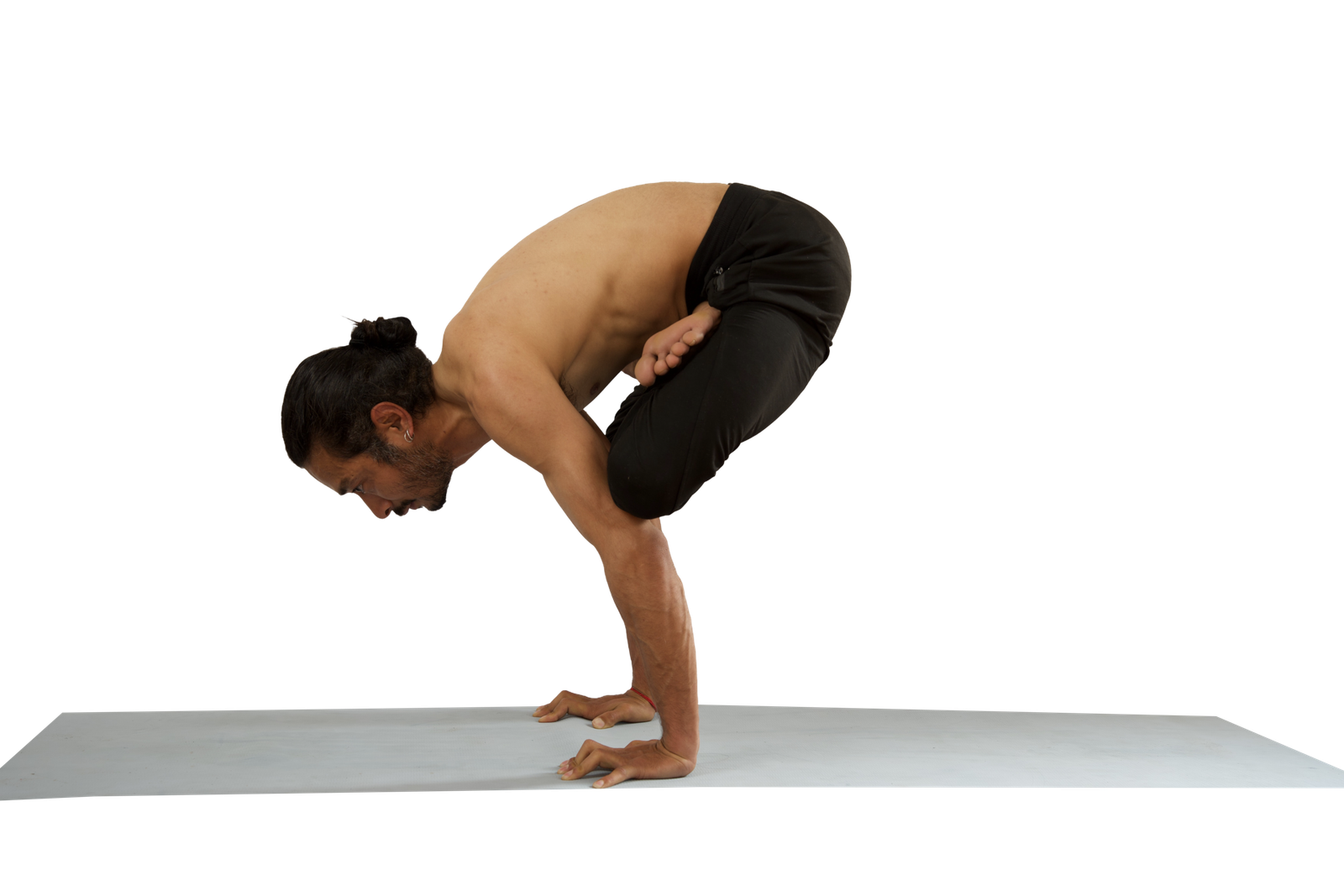
Introduction
What is Lotus Crane Pose?
Lotus Crane Pose is an advanced arm-balancing posture. It combines the stability of Crane Pose with the deep hip opening of Lotus Pose. The posture requires strong arms, stable shoulders and an engaged core, and also flexibility in the hips and knees, along with precise coordination and control.
Getting into position
Method 1
Step 1: Sit in Vajrasana. Come into a tabletop position – palms on the floor with wrists under the shoulders, knees together, feet together, flat on the floor. Inhale, exhale, and relax. Come into Salamba Shirshasana (Tripod Headstand Pose – hands and head on the floor in a triangle). Move the legs into Padmasana by placing one foot on the upper opposite thigh and the other foot on the opposite thigh.
Step 2: Inhale. While exhaling, lower the legs and rest them on the backs of the upper arms, as close to the armpits as possible (activating arms and hands to maintain balance).
Step 3: Inhale. While exhaling, press the palms into the floor, straighten the arms, lift the torso upward, and raise the head. Hold for a few moments to allow the body to adjust. Inhale. While exhaling, straighten the arms further and lift the buttocks upward. Hold with normal breathing for as long as comfortable.
Coming out of position
Slightly relax the body. Exhale. While inhaling, raise the knees. Uncross the legs one at a time. While exhaling, lower the legs to the floor. Come back into Vajrasana. Inhale, exhale, and relax.
Method 2
Step 1: Sit in Padmasana (Lotus Pose), place the palms by the sides of the hips with the fingers pointing forward. Inhale, exhale, and relax. Using the hands, come up onto the knees from Padmasana and place the arms straight and strong in front.
Step 2: Exhale. While inhaling, press the palms down into the floor (fingers spread as wide as possible), lift the crossed legs and hips up and slide the legs up from the forearms to the upper arms (lift and directly place by activating the core if possible), and rest the knees on the upper arms. Press the palms actively against the floor and look forward, focusing on a fixed point for balance. Hold with normal breathing for as long as comfortable.
Coming out of position
Slightly relax the body. Inhale. While exhaling, bend the elbows, and slowly lower the forehead toward the floor (if needed). While inhaling, slide the legs out from the arms, carefully bring the knees to the floor, and return to Padmasana under control. Uncross the legs one at a time. Inhale, exhale, and relax.
Precautions & Benefits
Benefits of Lotus Crane Pose
- Opens the hips and pelvis. Stretches the thighs, knees, and ankles.
- Strengthens the hands, arms, shoulders, neck, back, chest, abdominal muscles, and hip flexors.
- Stimulates abdominal organs and digestive system.
- Improves balance, neuromuscular coordination, and concentration.
- Enhances mental focus and confidence.
- Enhances joint stability in the wrists, elbows.
Preparatory Poses for Lotus Crane Pose
- Ardha Padmasana (Half Lotus Pose)
- Kakasana (Crow Pose)
- Bhujapidasana (Shoulder-Pressing Pose)
- Lolasana (Pendant Pose)
- Tolasana (Scale Pose)
- Parvatasana (Mountain Pose)
- Malasana (Garland Pose)
- Baddha Konasana (Bound Angle Pose)
Common Mistakes while doing Lotus Crane Pose
- Folding the legs into Padmasana forcefully without having enough hip, knees, and ankle flexibility.
- Placing the knees too low on the arms, which reduces stability.
- Not engaging the core effectively may cause the body to collapse downward.
- Keeping the elbows too wide or too close to each other.
- Shifting the weight too far back instead of forward onto the hands and fingertips.
- Looking down instead of forward may affect the balance.
- Entering or exiting the pose too quickly.
Contraindications
- Avoid if you suffer from migraines or herniated (slipped) discs.
- Avoid if you have chronic/serious wrist, shoulder, low back, hip, knee, or ankle problems.
- Avoid during pregnancy.
- Be careful if you have wrist, shoulder, low back, or knee issues; high or low blood pressure; diarrhea; abdominal hernia; or get dizzy easily.
